

From Carcassonne, we continued to drive to the coast of Southern France, stopping in Aigues-Mortes, which is another Bastille town with a large rampart around the old town.
Park Camargue
We drove on to Park Camargue, a half-hour south of Arles where semi-wild black bulls and white horses roam freely. 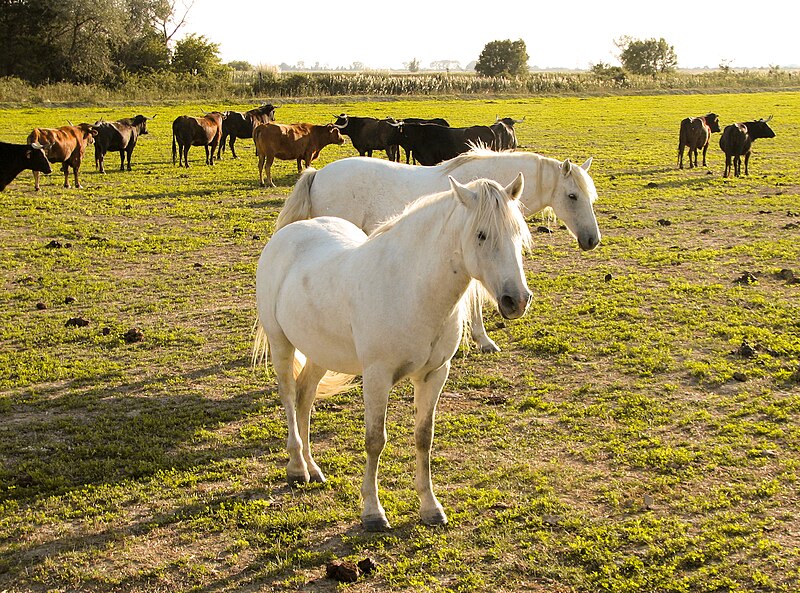

The “Gardians”
There are 2500 “Gardians” that live in traditional windowless huts. The huts have bull horns over the door that keep a watch over the horses and bulls and farm the land. (hut on far right)


Camargue White Horses
The pre-historic Camargue White Horses are considered to be one of the oldest breeds in the world, going back some 17000 years. Interestingly, their hooves have adapted to the marshy wet environment.

The Camargue is where the estuaries of the Rhone river meet the sea, forming a combination of lagoons, sand bars, marshes, salt flats, and waterfront. There are birds, waterfowl, wild boars, beavers, badgers, water snakes, turtles, reeds, sea lavender, and pink flamingos (until March, when they migrate to Africa). The marshes are used for wine, salt, and rice production. The wines are known as Les Vins des Sables or “The Sand Wines”, and can be traced back to the time of the Crusades.
The Lookout Tower
A fellow we were chatting with in Aigues-Mortes, (actually the “nice” young man who sold us a new GPS and ensured us absolutely and repeatedly that it had maps installed for all of Western Europe. Later we found out that only France was installed on the GPS, which resulted in us wandering aimlessly all over Italy, Slovenia and Croatia), told us about a lookout tower over the wetlands of Park Camargue.


Compared to the gorgeous rolling green hills of Southern France, the marshes were completely different.

We actually spoke to one of the “Gardians”. He said that the white horses that they ride for herding the wild bulls and wild horses, have been broken to ride.

A Romantic Wilderness
Looking across the fields over this old wooden farm gate… 


A romantic wilderness, one of those landscapes that seems to have survived centuries of human habitation almost unmarred by tourism.


